
Last updated September 20, 2026
Full 25-point door and opener safety check with every visit - springs, cables, rollers, tracks, and your LiftMaster or Chamberlain opener included
You get a price before we start. It does not change when the truck arrives.

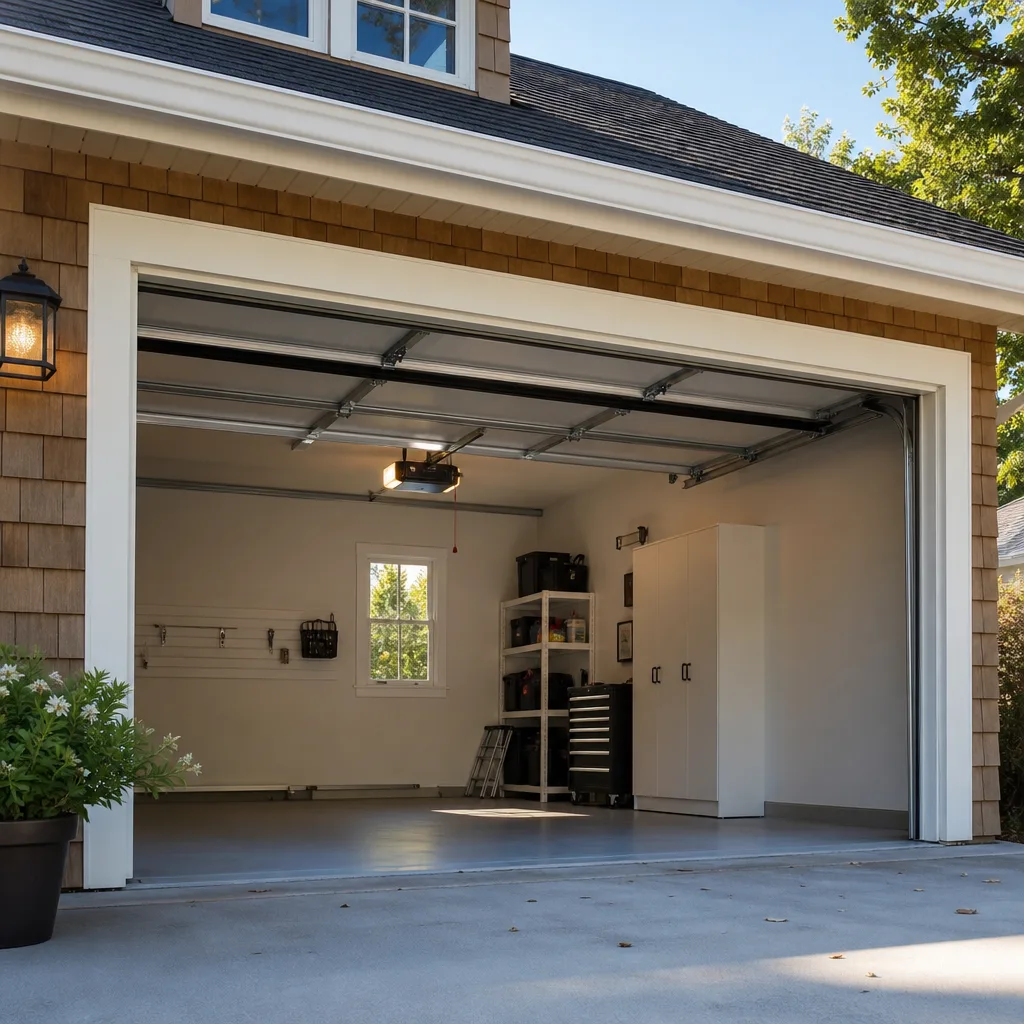
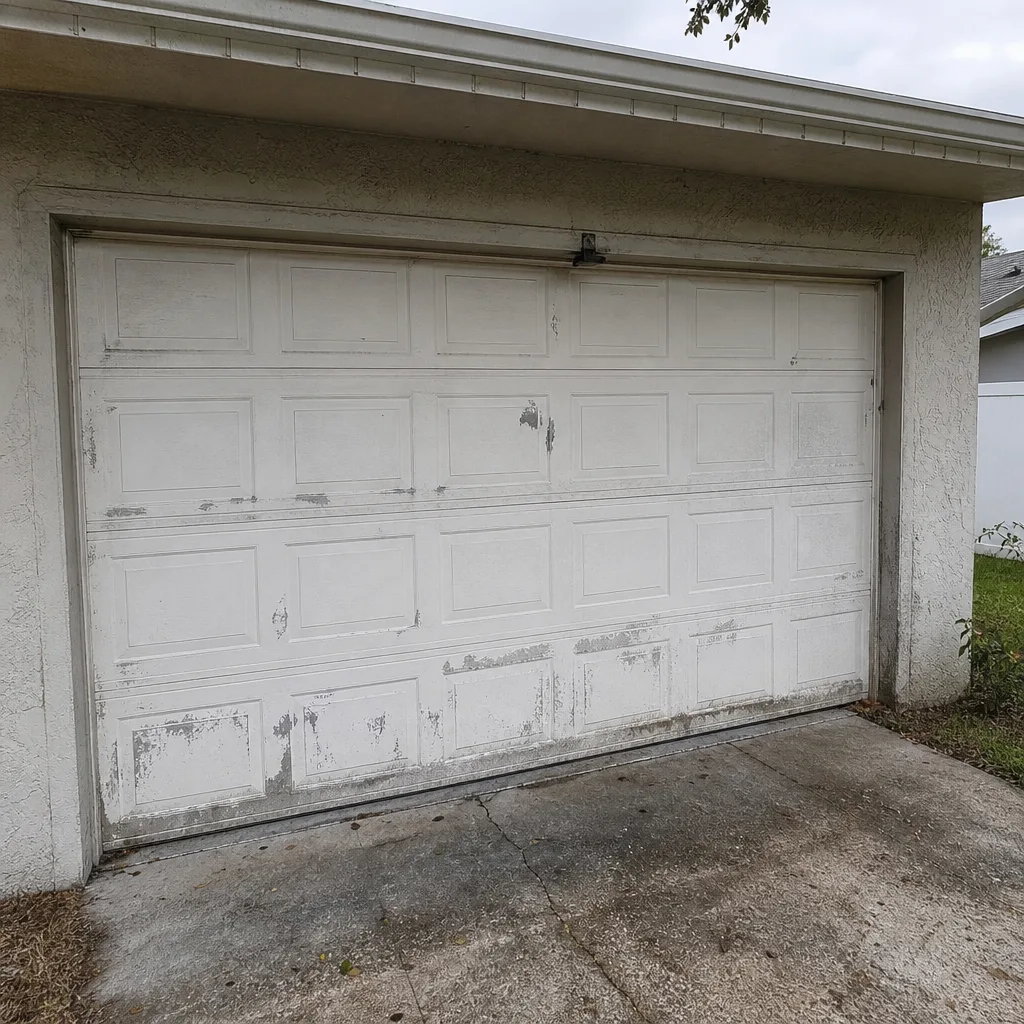 Before
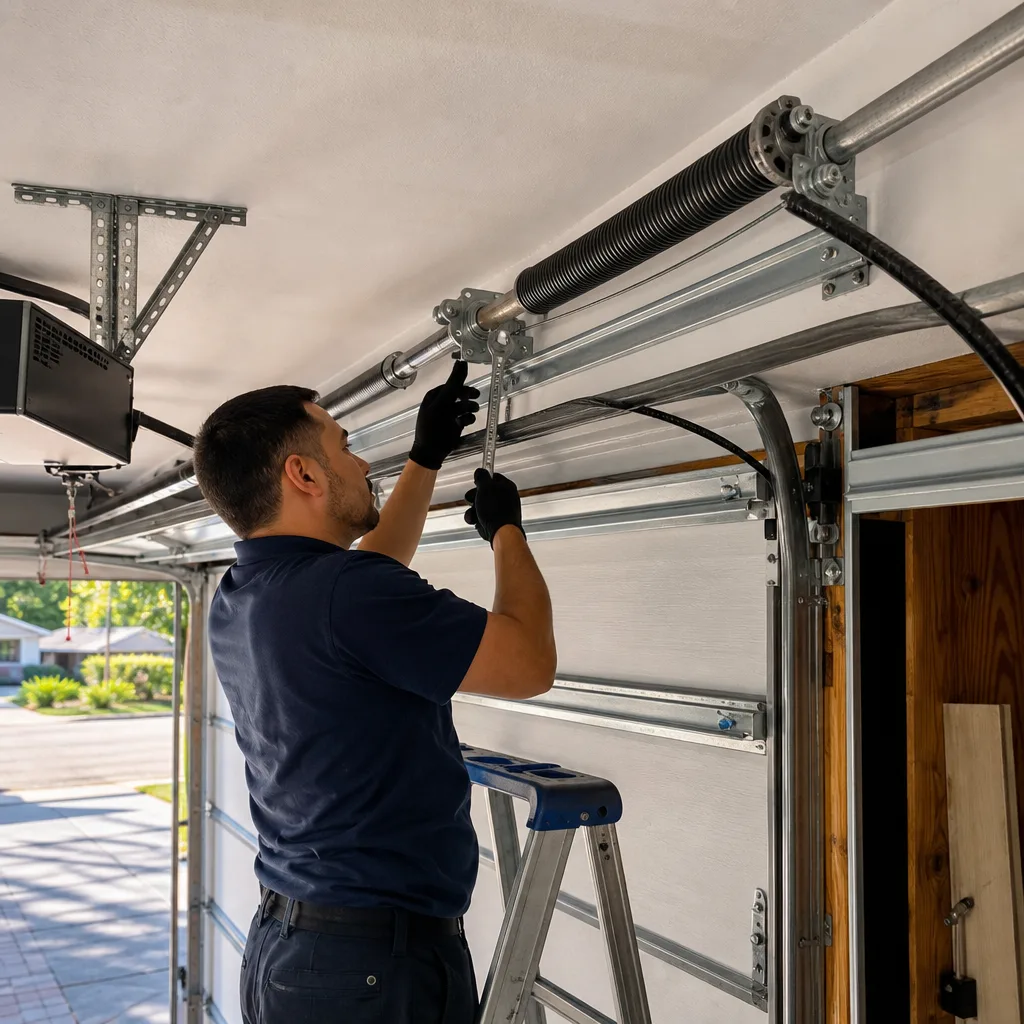 After
After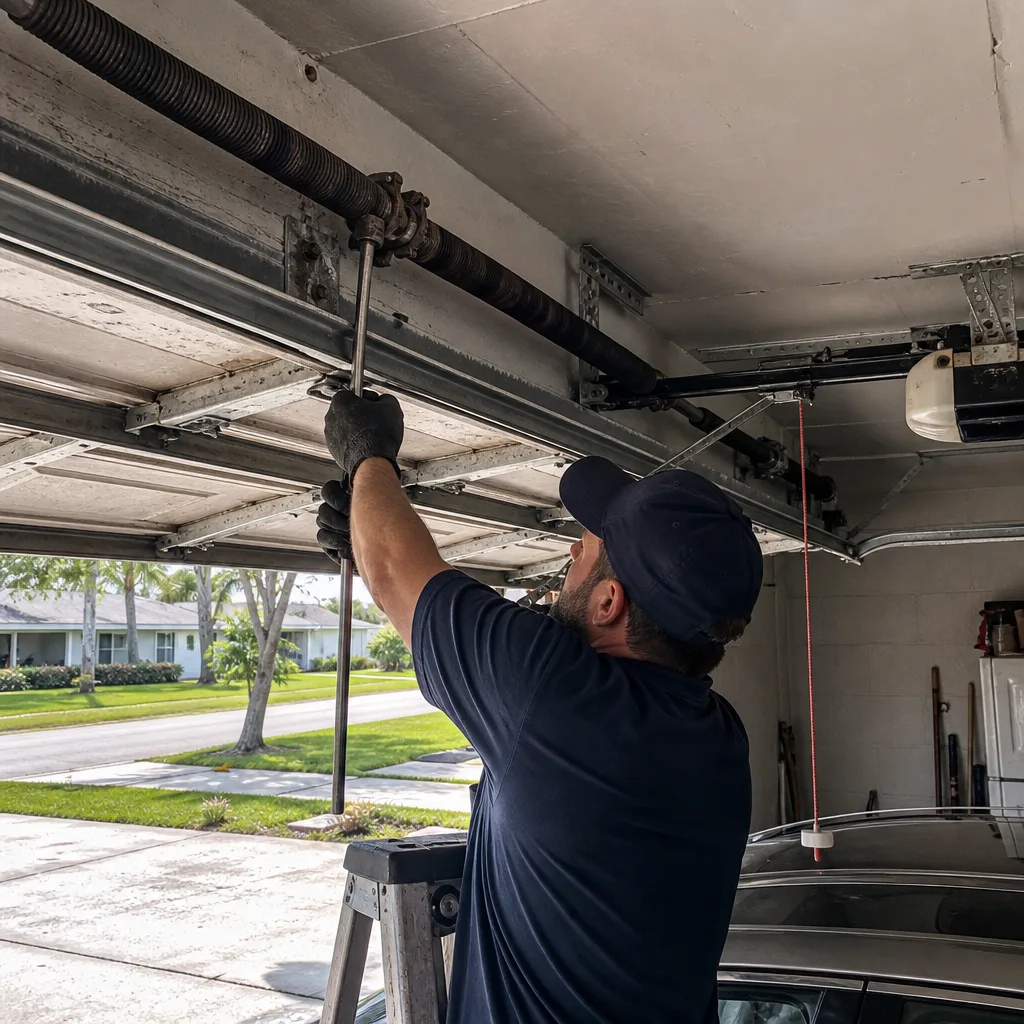 Before
 After
After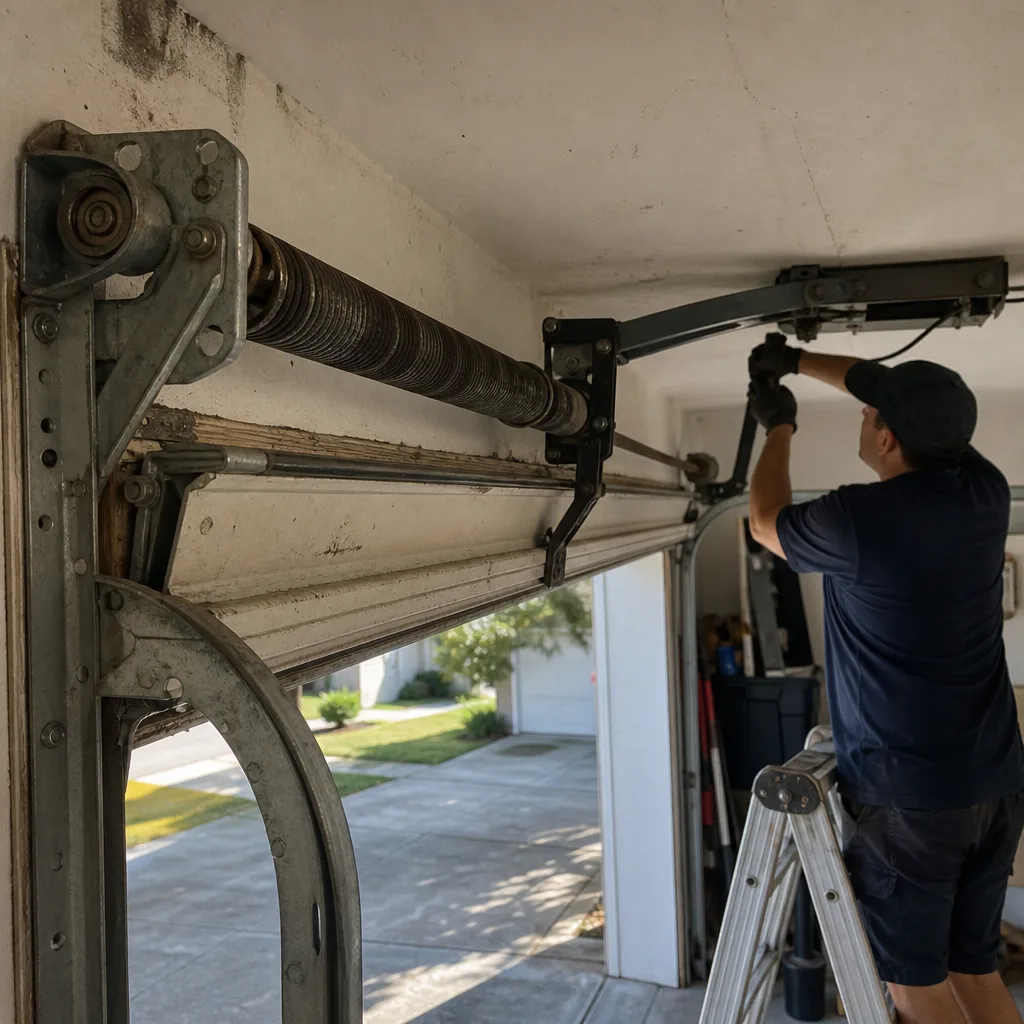 Before
 After
AfterSeasonal Garage Door Care for Clearwater: Year-Round Homeowner’s Guide
The most common month for garage door spring failure in coastal Florida isn’t winter. It’s October, when the post-storm humidity spike collides with the first real temperature swings of autumn, accelerating metal fatigue in springs that already spent summer absorbing thousands of extra cycles. Clearwater doesn’t have four seasons in any traditional sense. It has a hurricane preparation window, a peak-storm period, a post-storm recovery phase, and a dry-season reset. Each one creates a distinct set of mechanical stresses that a standard seasonal maintenance calendar, the kind written for Atlanta or Charlotte, completely ignores. This guide reframes the year around those four Clearwater-specific phases and tells you exactly what to check, when to check it, and when it’s worth making a call. For more guides & resources, visit our blog.
Quick Answer
Seasonal garage door care in Clearwater should follow four phases rather than calendar seasons: pre-hurricane preparation (April to May) focused on wind-load hardware and manual disconnect testing, active-storm monitoring (June to September) with post-storm inspections after any named system within 100 miles, a post-storm recovery checklist (October) addressing salt residue and cable drum debris, and a dry-season reset (November to March) when lubrication and spring tension adjustments hold most reliably. Homeowners should ignore the opener manufacturer’s annual service reminder and instead follow a coastal service interval determined by storm activity and salt exposure, not the calendar.
Table of Contents
- Why Clearwater’s Climate Breaks the Standard Maintenance Calendar
- Phase One: Pre-Hurricane Preparation (April to May)
- Phase Two: Active Storm Season Protocol (June to September)
- Phase Three: Post-Storm Recovery Checklist (October)
- Phase Four: Dry-Season Reset (November to March)
- Why the Manufacturer’s Annual Reminder Is Wrong for Clearwater
- Common Mistakes to Avoid
- When to Call a Professional
- Frequently Asked Questions
- The Bottom Line
BeforeAfterWhy Clearwater’s Climate Breaks the Standard Maintenance Calendar
The garage door maintenance schedules printed in opener manuals and posted on national hardware blogs assume a climate with dry winters and moderate summer humidity. Clearwater gets neither. The city sits on a peninsula between the Gulf of Mexico and Tampa Bay, which means the air is saturated roughly nine months a year. Salt, not cold, is the primary corrosive agent. The average relative humidity in Clearwater runs above 70 percent from May through November, with dew points that keep metal surfaces damp overnight even when it hasn’t rained in days.
What that means for a garage door is straightforward: every galvanized surface, every exposed bearing, every spring coil is fighting a slow chemical attack that a homeowner in Denver or Dallas never has to think about. Torsion springs, the coiled units mounted above the door that do the actual lifting, are made of high-carbon steel. In Clearwater’s humidity, the protective oil film on a spring burns off faster, and pitting begins sooner. Once pitting starts, the spring’s fatigue life drops sharply. The spring that failed in October in a Countryside driveway wasn’t fine in September. It had been failing, invisibly, since June.
We mention Countryside specifically because we’ve changed springs in that neighborhood in every month of the year. The failure pattern doesn’t follow a temperature curve. It follows a humidity curve. That’s why a coastal service schedule makes sense where a calendar schedule doesn’t. The rest of this guide is organized around that observation.
If your door is at the point where seasonal care isn’t enough, our Garage Door Repair in Clearwater page covers common failure modes and what we look for during a service call.
Phase One: Pre-Hurricane Preparation (April to May)
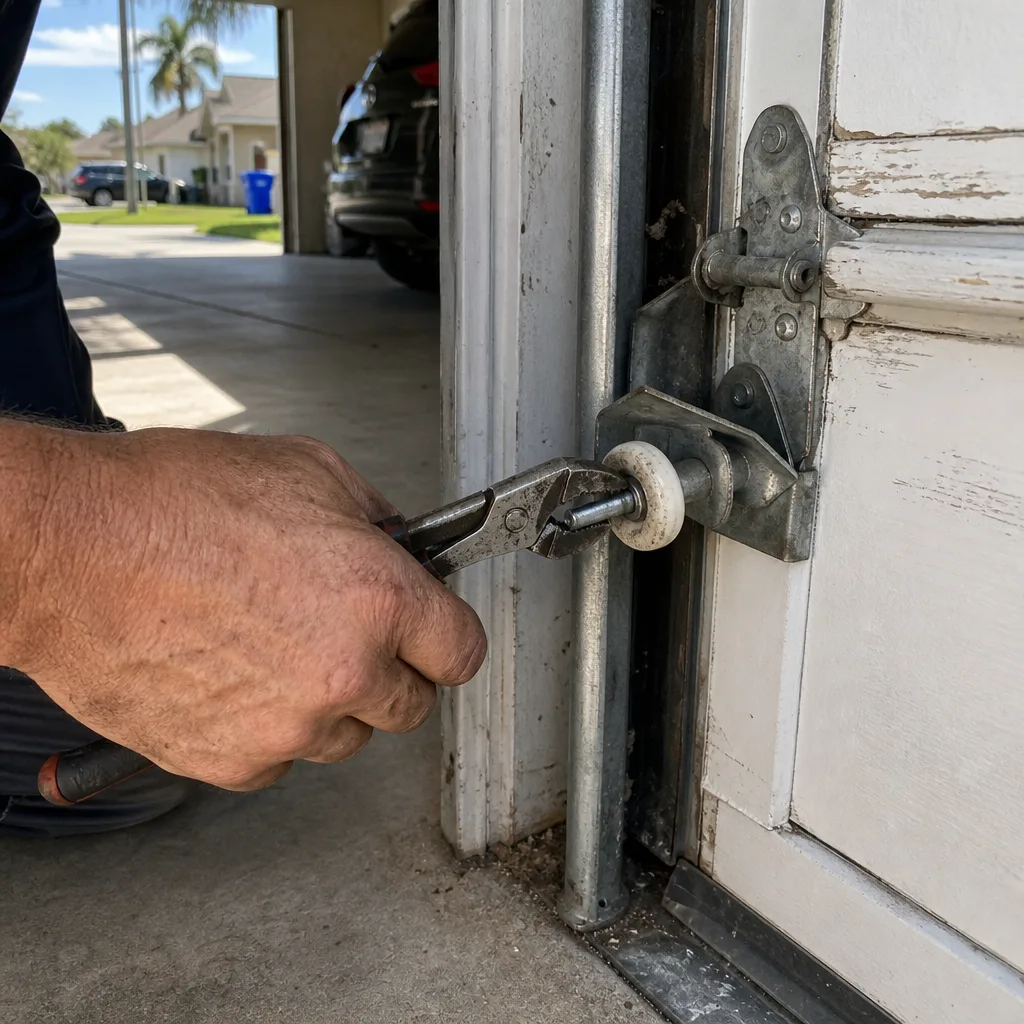
The first phase of Clearwater seasonal garage door care runs from roughly mid-April through May. It’s the window when hurricane-season prep becomes real and when the mechanical work you do now pays off through October. The goal in this phase isn’t lubrication. It’s structural verification. A garage door is a giant sail during a wind event, and every piece of hardware that transfers wind load to the framing needs to be seated correctly.
Checklist for April and May in Clearwater
- Wind-load hardware verification. Walk the perimeter of the door with a flashlight and inspect every hinge, bracket, and track mount. Look for bolts that have backed out, brackets that have shifted, and rust staining that indicates water intrusion at the connection point. In Clearwater homes built before the 2002 Florida Building Code updates, the wind-load reinforcement requirements were looser. If your home predates 2002, pay particular attention to the jamb brackets, the metal plates that hold the vertical tracks to the wall framing. These are the first points to fail in a storm.
- Manual disconnect test. Every automatic garage door opener has a red cord hanging from the trolley carriage, the mechanism that travels along the rail and pulls the door. When you pull that cord, the door disengages from the opener and can be moved by hand. Test this in April. If the cord is stiff, broken, or difficult to reach, address it now. During a power outage, this cord is the only way to open the door manually. Finding out it’s jammed during a storm is the wrong time.
- Reinforcement strut inspection. Struts are the horizontal metal bars mounted across the interior face of each door section. They’re what keep a 16-foot-wide door from bowing under wind pressure. Check that each strut is firmly attached across its full length, with no gaps at the ends and no missing fasteners. If a strut is loose or was removed during a previous repair and never replaced, the door’s wind rating drops significantly.
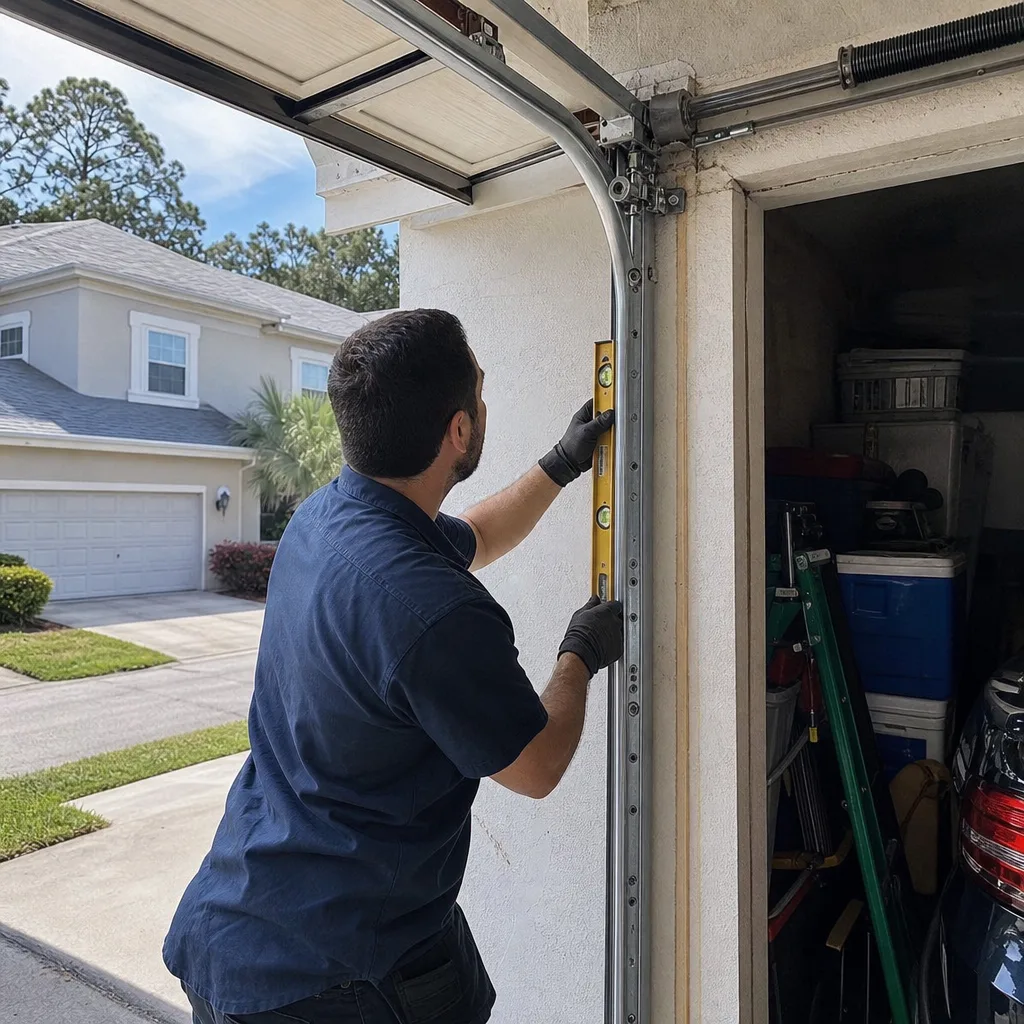
- Track alignment check. Stand inside the garage with the door closed and sight down both vertical tracks. They should be straight and parallel. Any inward or outward bow means the track has been knocked out of alignment, likely by an earlier impact. Misaligned tracks cause roller drag, which increases wear on the opener motor and makes the door more likely to bind during high wind.
- Opener force-settings test. Close the door and place a 2×4 flat on the floor in the door’s path, then trigger the opener. The door should reverse within a second or two of contacting the wood. If it doesn’t reverse, the force settings are too high or the safety beam is misaligned. Either way, the door is a hazard, and in a hurricane scenario where debris is moving around, a door that doesn’t reverse properly is more dangerous than a door that won’t open.
We can’t count the number of times we’ve responded to a post-storm call in Clearwater and found that the root cause was a pre-storm inspection that never happened. The photo record we include on every Garage Door Installation in Clearwater job shows exactly what a properly seated bracket looks like, which makes it easier to spot a problem when it starts.
Phase Two: Active Storm Season Protocol (June to September)
From June through September, the maintenance posture shifts from preparation to monitoring. You’re not doing substantive work during this phase. You’re watching for damage after weather events and making decisions quickly when something changes. Clearwater sits in a unique position on Florida’s west coast. Storms that make landfall in the Panhandle or south of Tampa Bay can still push significant wind and rain into the city, even when the center never comes close. The rule we give homeowners is this: after any named storm passes within 100 miles of Clearwater, do a five-minute walkaround of your garage door. Even if there was no direct impact. Even if the storm only produced light rain. Wind damage doesn’t require a direct hit.
Post-Named-Storm Walkaround: The Five-Minute Version
- Cycle the door once. Open and close it fully, listening. Anything that wasn’t there before, a grind, a squeal, a rhythmic thump, gets noted. A new noise is a new problem. It doesn’t fix itself.
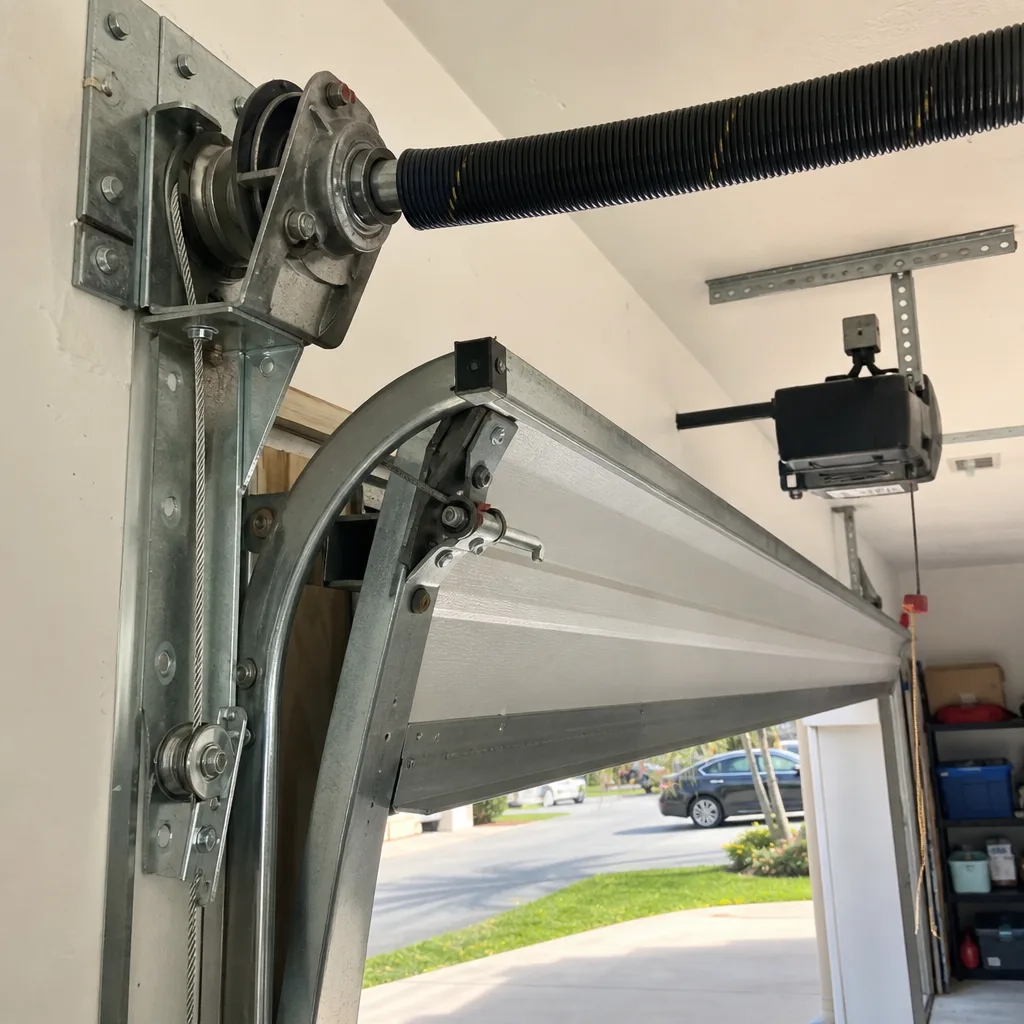
- Check the cable drums. Look at both ends of the torsion bar above the door, where the lifting cables wind onto spool-like drums. Debris from wind-driven rain can carry leaves, pine needles, and small twigs into the garage through vent gaps and around the door’s top edge. If any of that ends up inside the cable drum, the cable can wind unevenly and eventually throw itself off the drum. That’s a door that comes crashing down or hangs crooked. Both are serious.
- Look at the bottom seal. The rubber strip along the bottom edge of the door is your primary defense against wind-driven water intrusion. After a storm, inspect it for tears, gaps, or areas where it’s pulled away from the aluminum retainer. Even a small gap lets water pool inside the garage, which is where rust and mold start.
- Check for salt film. This is the one most non-coastal guides miss. After any onshore wind event in Clearwater, a fine film of salt settles on every exposed surface, including your door panels, tracks, and hardware. You can feel it on your fingers. It feels slightly gritty. If you leave it, it accelerates corrosion. If you wipe it off within a day or two, the damage is minimal. We’ll cover cleaning procedure in the next section.
- Test the opener after the power comes back. If you lost power during the storm and ran the door manually, test the opener once power returns. Confirm the emergency disconnect re-engages cleanly and the door doesn’t jerk or hesitate. If the logic board, the small computer inside the opener that controls operation, took a voltage spike during a brownout, it may need replacement. Symptoms include the door opening but not closing, or the lights flickering on the unit.
If the walkaround turns up anything structural, a snapped cable strand, a bent track, a panel that’s separated at the seam, stop using the door and make the call. A door with one broken cable can still be opened by the opener, but it’s being dragged up unevenly, and the stress on the remaining cable and the spring is extreme. That’s how a small problem becomes a $1,200 problem. For opener-specific issues, our Garage Door Opener Repair & Installation in Clearwater page explains what we test and how we diagnose board failures versus mechanical issues.
Phase Three: Post-Storm Recovery Checklist (October)
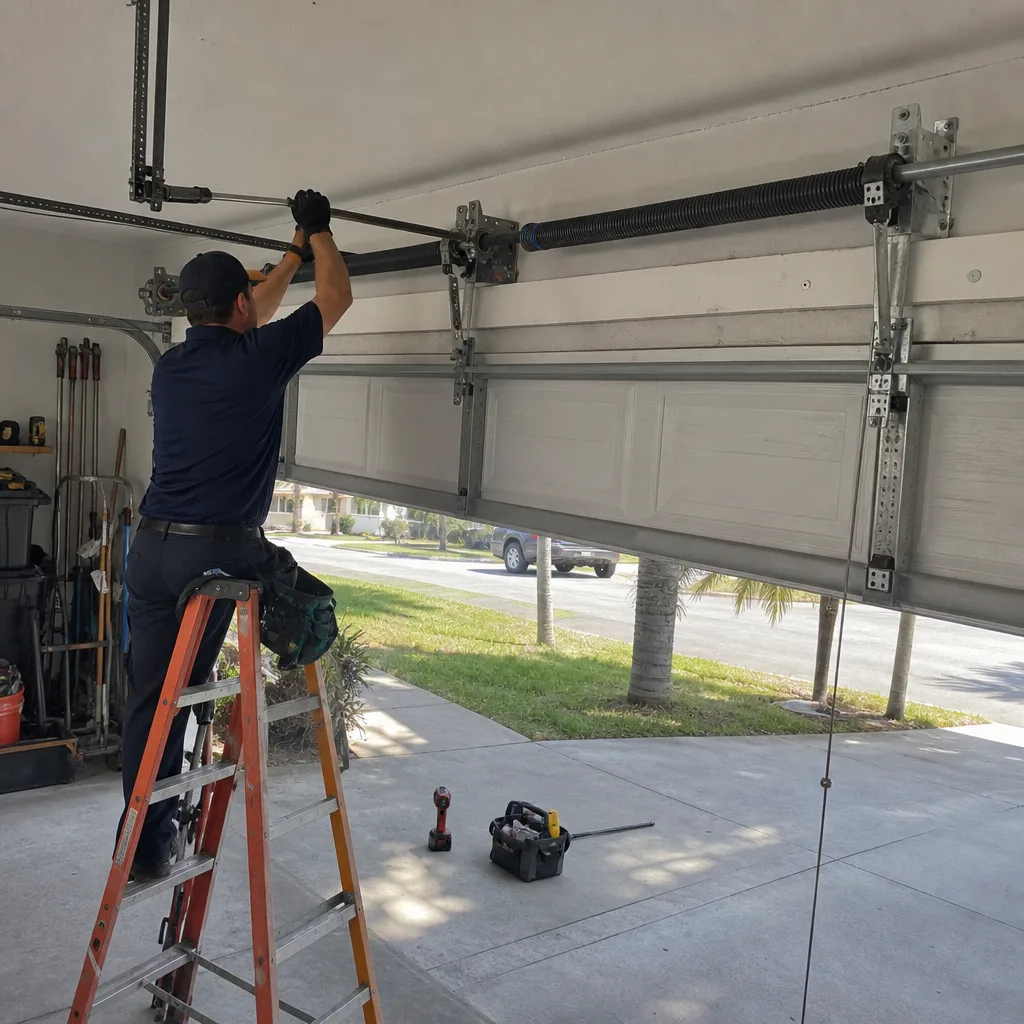
October is the month when Clearwater homeowners discover what the summer did to their garage doors. The humidity spike after September’s rains, combined with the first cool fronts that create overnight temperature drops, is brutal on metal components. Springs that were marginally fatigued in August snap in October. Cables that have been quietly fraying for months let go on the first crisp morning. This is why October is, in our experience, the busiest month for spring failures across Clearwater, from Clearwater Beach to Safety Harbor to the neighborhoods east of McMullen Booth Road.
The October recovery checklist is the most substantive of the year. It’s not just inspection. It’s cleaning, testing, and decision-making.
October Recovery Checklist for Clearwater Homes
- Salt residue cleaning on tracks and hardware. Mix one cup of white vinegar with one gallon of warm water. Wipe down both vertical tracks, the horizontal tracks, all hinges, brackets, and the torsion spring with a cloth dampened in the solution. The vinegar neutralizes the salt. Follow with a dry cloth. Do not use a pressure washer anywhere near the tracks or opener. Water forced into the bearings or the opener’s internals causes more damage than the salt it removes.
- Cable drum inspection for debris intrusion. This time you’re not just looking. You’re cleaning. Use a flashlight and a small pick or stiff brush to remove any debris caught in the spiral grooves of the cable drums. Windblown debris that got in during September storms has had weeks to compact. A clogged drum groove causes the cable to stack unevenly, which throws the door out of balance. It’s a ten-minute job that prevents a broken cable.
- Opener battery backup test. If your opener has a battery backup unit, typically a small box mounted behind the motor housing, test it in October. Unplug the opener from the outlet and trigger the remote. The door should open and close from battery power. After 30 minutes, plug it back in. If the battery won’t hold a charge, replace it before the next outage. Most backup batteries last three to five years in Clearwater’s heat. They don’t fail gracefully, they just stop working.
- Spring inspection. This is the big one. Look at the torsion spring above the door. If you see a gap in the coil, the spring has snapped and needs replacement. But also look for surface rust and pitting. A spring with significant pitting hasn’t failed yet, but its fatigue life is compromised. In our experience, a Clearwater spring with visible pitting typically has six to eighteen months of service left. That’s not a guess you want to test. If you’re unsure, document it with photos and have it evaluated.
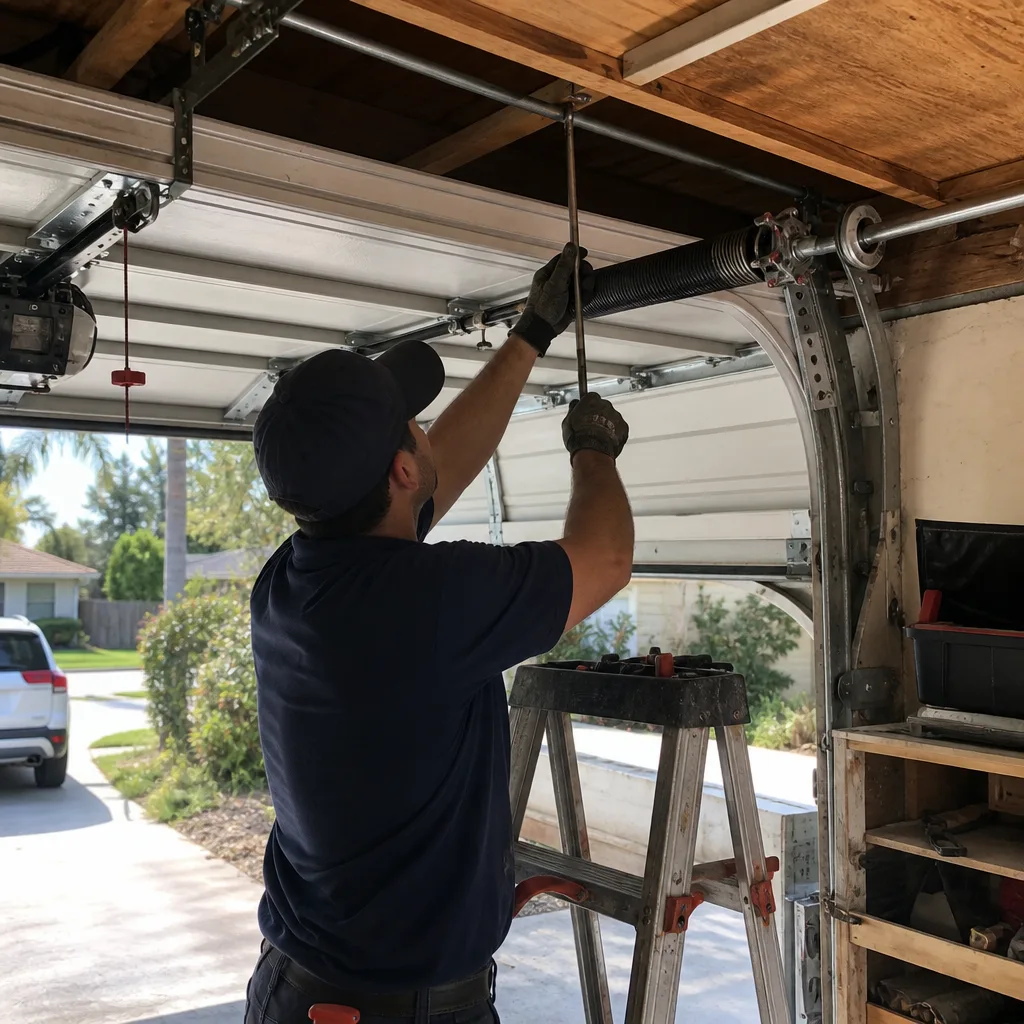
- Balance test. Pull the red emergency cord and manually lift the door to chest height, then let go. It should hold its position. If it drops, the spring is no longer providing adequate counterbalance. If it rises, the spring is overtensioned. Either way the opener is working harder than it should, and the fix is a tension adjustment or spring replacement. The dry season is the right time to do it.
- Full lubrication pass. October is not actually the best month for lubrication in Clearwater. That comes in Phase Four. But if the door is loud and hasn’t been lubricated in over a year, a light application now prevents further wear before the dry season arrives.
Everything in this phase is about stopping cumulative damage before it becomes a failure. The photo record we provide on every service call, the one we’ve been doing since 2015, is especially useful here. It gives you a baseline of what your components looked like at a known point in time, which makes change over months or years visible. That’s Clause 4 of The Haven Standard at work.
Phase Four: Dry-Season Reset (November to March)
November through March is the single best window for meaningful garage door maintenance in Clearwater. The reason is humidity. When relative humidity stays below 65 percent for sustained periods, two things happen: lubricants spread and adhere properly without being diluted by condensation, and spring tension adjustments hold more reliably because the metal isn’t expanding and contracting with daily moisture swings. A tension adjustment done in November will still be accurate in February. The same adjustment done in July might need re-doing by September.
This is the window where you should be doing the real work.
Dry-Season Maintenance Tasks for Clearwater Garages
- Lubricate everything that moves. Use a lithium-based grease on the torsion spring, the bearing plates at each end of the torsion bar, and the hinge pivots. Use a silicone spray on the rollers, tracks, and the opener rail. Do not use WD-40. It’s a solvent, not a lubricant, and it strips the protective coating that’s already there. The difference matters in a salt-air environment.
- Spring tension adjustment. This is a task for a trained technician, not a DIY job. Torsion springs are under hundreds of pounds of tension, and the wrong adjustment can cause serious injury. But from a homeowner’s perspective, November through March is when you should schedule this work if the balance test from October showed problems. The adjustment will hold through the summer.
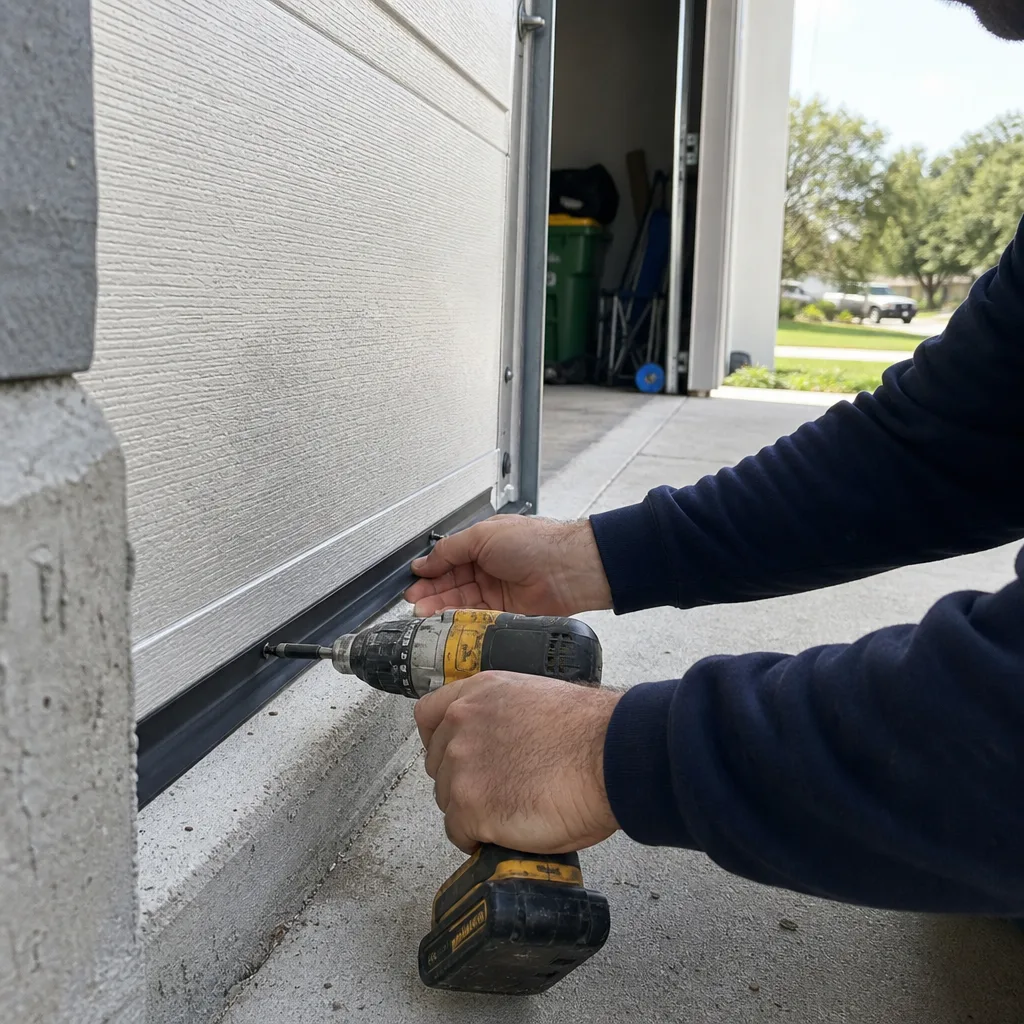
- Weatherstrip replacement. The bottom seal and the side weatherstripping degrade faster in Clearwater than in most of the country because UV exposure is year-round and salt accelerates rubber breakdown. If your seal is cracked, flattened, or no longer makes contact with the floor, replace it in the dry season. It’s a straightforward job and it directly affects your cooling bill and your resistance to storm-driven water.
- Opener gear and belt inspection. If your opener uses a belt drive, check the belt for cracks or fraying. If it uses a screw drive, check for visible wear on the screw. Opener noise that’s been getting progressively worse over the summer often means the drive gear inside the opener is wearing out. Dry season replacement is easier because the part isn’t fighting humidity-related swelling.
- Complete cycle count. Garage door springs are rated for a certain number of open-close cycles, typically 10,000 for standard springs. The average Clearwater homeowner cycles their door four to five times per day, which is on the high side because so many of us use the garage as the primary entrance. That’s roughly 1,600 cycles per year. A spring that’s five years old has used 8,000 of its 10,000 rated cycles. If you don’t know when your springs were last replaced, the dry season is the time to have them evaluated. We’ve seen springs in Clearwater homes fail before the five-year mark because of this cycle count combined with salt pitting.
If your door is nearing the end of its rated cycle life or is showing signs of structural fatigue, fall or winter replacement makes sense. We install every major brand including LiftMaster, Chamberlain, Genie, and Raynor, with a flat written price delivered before any work starts. That’s Clause 1 of The Haven Standard, the same clause that makes ‘call for a quote’ something we never say.
Why the Manufacturer’s Annual Reminder Is Wrong for Clearwater
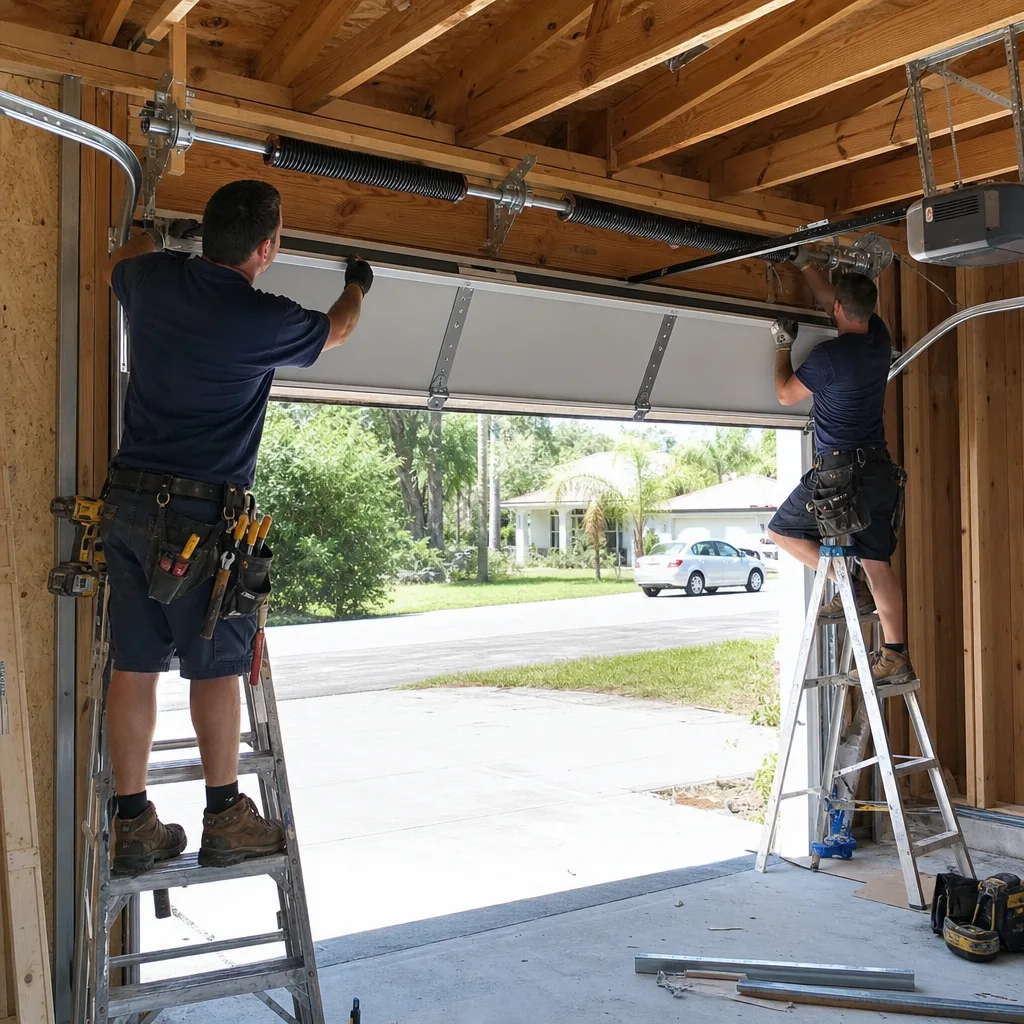
Most garage door opener manufacturers program a service reminder into their units, a blinking light or a digital message that appears once every 12 months. It’s well intentioned. It’s also wrong for coastal Florida, where salt, wind, and humidity inflict damage on an accelerated schedule that calendar-based reminders ignore.
Here’s the problem. An annual service in Clearwater, done in, say, May, leaves a 12-month gap between lubrications. But the period from June through September is exactly when the door needs the most attention. By the time the next May rolls around, the door has endured a full storm season, months of salt film, and a humidity spike with zero intervention. The manufacturer’s reminder is designed for a national average. Clearwater isn’t the national average.
A realistic coastal service interval looks more like this:
- Basic inspection and salt removal: Every three to four months during the humid season, which in Clearwater means April through November. This is the five-minute walkaround plus a salt wipe. It doesn’t require a technician, it requires habit.
- Lubrication and balance check: Every six months, with the primary service in November and a lighter mid-year check in May. The November service is the significant one, the May service is confirmation heading into storm season.
- Full professional service with tension verification and component inspection: Once per year, between November and February, when adjustments hold and the service has maximum durability.
- Post-storm walkaround: Not scheduled. Event-driven. After any named storm within 100 miles of Clearwater, do the five-minute version.
There’s a reason we mention specific intervals rather than saying “call us and we’ll handle it.” We’ve been doing this since 2015, and the homeowners who follow a rhythm like the one above have fewer surprises. The ones who wait for the opener’s blinking light to schedule service are the ones we meet on emergency calls at 7 a.m. in October with a snapped spring.
For a broader look at what falls under garage door service throughout the year, the Servo Garage Doors Clearwater home page outlines the full scope of what we do and how The Haven Standard applies to every visit.
Common Mistakes to Avoid
- Waiting for the opener’s annual reminder. The reminder is a national average. Clearwater’s salt and humidity don’t follow a 12-month calendar. You’ll be under-servicing your door by six months or more in the window that matters most.
- Using WD-40 as a lubricant. It’s a solvent. It strips the protective layer and leaves bare metal exposed in a salt-air environment. Use lithium grease on springs and hinges, silicone on rollers and tracks.
- Ignoring a garage door that works “fine” after a storm. Storm damage is often invisible. A cable that’s been knocked slightly off its drum still opens and closes, until it doesn’t. The five-minute walkaround exists because the door won’t always tell you something’s wrong.
- Doing the balance test and adjusting springs yourself. The balance test is fine for homeowners. The adjustment is not. Torsion springs store enough energy to break bones or worse. We have the equipment and the training. This is the one area where DIY is genuinely dangerous, not just inconvenient.
- Letting salt film sit on hardware for weeks. Salt doesn’t need weeks to start working. The vinegar-and-water wipe takes ten minutes and extends the life of your tracks, hinges, and springs by years in Clearwater. The people who skip it are the ones paying for premature rust-related replacement.
- Lubricating in the middle of summer. In July, the humidity dilutes lubricant and makes it run off before it can penetrate. The same application in January lasts three times as long. Timing matters more than product.
- Replacing the opener when the door is the problem. We see this constantly. A homeowner’s door is unbalanced, the opener is straining, the motor burns out, and they replace the opener only to have the new one fail the same way. The opener is never the root cause of a balance problem. Fix the door first. This is why we photograph the failed component before quoting any replacement.
When to Call a Professional
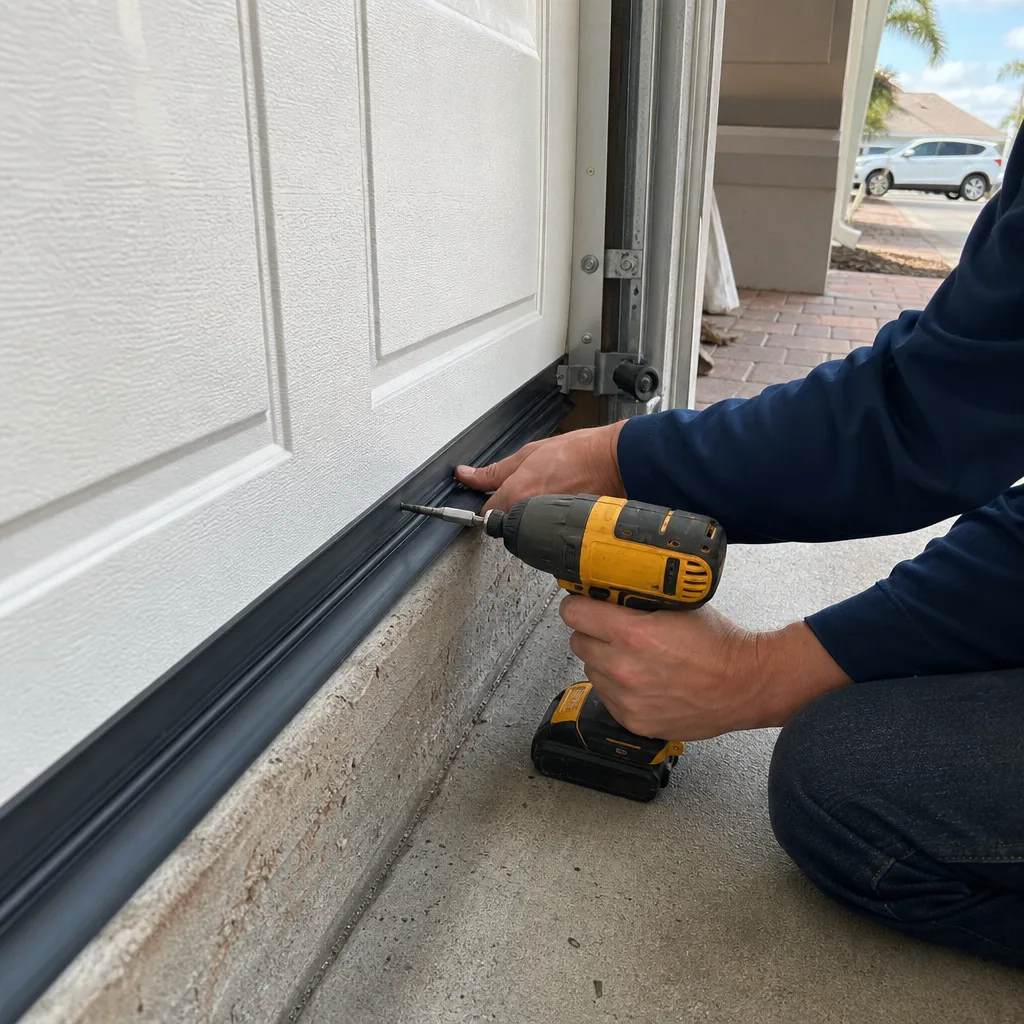
Some tasks in this guide are homeowner work. Others are not. Call a professional when you see a gap in a torsion spring coil, when the balance test shows the door dropping or rising on its own, when a cable has visible fraying or has come off the drum, when the opener reverses without reason or fails to reverse when it should, when a track is visibly bent or separated from the wall, or when the door makes a new and persistent noise you can’t identify. These are safety issues, not convenience issues. A door that falls because a cable let go is a serious hazard, and the components involved are under tension that can cause serious injury. Servo Garage Doors Clearwater offers free estimates throughout Clearwater. Call (727) 485-0719, and we’ll give you a flat written price before any work starts.
Frequently Asked Questions
In Clearwater’s salt-air environment, lubricate moving components every six months, with the primary application in November or December when humidity is low and lubricant adheres properly. A lighter mid-year application in May or June carries the door through the humid season. Use lithium grease on the spring and hinges, silicone spray on rollers and tracks. Never use WD-40, which strips protective coating rather than lubricating. Call (727) 485-0719 if you’re unsure what to use, and we’ll point you to the right products.
October spring failures in Clearwater happen because of cumulative fatigue from summer cycle counts and the first real temperature swings of autumn, which cause metal expansion and contraction in a spring that’s already compromised by salt-induced pitting and months of daily use. The snap in October is the endpoint of a process that started in June. That’s why we recommend a spring evaluation in the dry season rather than waiting for failure. For an exact replacement quote with a written price before work begins, call (727) 485-0719.
Yes. Named storms within 100 miles of Clearwater can still produce wind-driven rain and salt spray that deposits debris in cable drums and a corrosive salt film on tracks and hardware. The five-minute post-storm walkaround catches these issues before they become failures. The inspection is free in terms of time, and the alternative is discovering the problem when the door stops working.
Garage Door Cost Breakdown: The Clearwater Homeowner’s Reference for 2026 covers pricing in detail, but spring replacement in Clearwater typically runs $180 to $340 for a standard torsion spring, including labor, with heavier-duty springs and dual-spring systems at the higher end. Every job is quoted with a flat written price and written scope delivered before any work starts, per Clause 1 of The Haven Standard. No surprises on the invoice. Call (727) 485-0719 and we’ll give you the price range for your specific door over the phone.
We don’t recommend it. DIY vs Professional Garage Door: The Clearwater Homeowner’s Decision Guide explains why torsion springs are under several hundred pounds of tension, and a wrong move can cause serious injury, bone fractures, and worse. The winding bars used to adjust these springs are not standard tools, and the technique is not something to learn from a video. This is the one repair where savings don’t justify the risk. We carry all major brands including LiftMaster, Chamberlain, Genie, and Raynor, and we’ll have your spring replaced safely, with a written price before we start.
In Clearwater, a standard 10,000-cycle torsion spring lasts roughly five to seven years at an average of four to five open-close cycles per day, with salt exposure and humidity shortening that window for some homeowners. High-cycle springs rated for 25,000 to 30,000 cycles can last a decade or more. If you don’t know your spring’s age or cycle rating, have it evaluated during the dry season. The inspection takes minutes, and we’ll photograph the spring so you have a documented record of its condition.
The Bottom Line
The Complete Guide to Garage Door in Clearwater covers the fundamentals, but the key point is that Clearwater’s garage doors don’t fail on a national calendar. They fail on a coastal one, driven by salt, humidity, storm events, and the daily cycle counts of homes where the garage is the front door. The solution isn’t more frequent generic maintenance. It’s the right maintenance in the right window: structural verification in April and May, event-driven inspections from June through September, a serious recovery checklist in October, and the dry-season work from November to March when adjustments and lubrication actually hold. Follow that rhythm and the only surprises left are the ones you can see coming months in advance.
Written by Marcus Deller, Owner at Servo Garage Doors Clearwater, serving Clearwater since 2015.